Who needs BRCGS certification?
BRCGS certification is required by food manufacturers, packaging producers, storage and distribution companies, and consumer product suppliers that sell to major UK and international retailers. Most large supermarket chains and retail buyers list it as a minimum supplier requirement. This article covers which business types need certification, which BRCGS standards apply to each sector, and when certification becomes a contractual obligation rather than a voluntary choice.
Key takeaways
- Check buyer supplier manuals before selecting which BRCGS standard to pursue.
- Retailers including Tesco, Lidl, and Marks & Spencer mandate BRCGS as a supplier condition.
- Food and drink manufacturers face the strongest commercial pressure to hold BRCGS certification.
- Losing BRCGS certification can end a retail contract without formal notice or appeal rights.
- Contact your top three customers directly to confirm whether a BRCGS certificate is required.
- Select the correct standard before registering, as applying under the wrong one delays audits by months.
- Gap analysis follows registration, comparing existing documentation and processes against the standard’s requirements.
What BRCGS certification covers and how it works
| Grade | What It Means | Re-audit Frequency | Retailer Listing Impact |
|---|---|---|---|
| AA | Highest pass — unannounced audit | Annual | Meets listing requirements without additional audits |
| A | Strong pass | Annual | Meets listing requirements without additional audits |
| B | Satisfactory pass | Annual | Generally accepted; may prompt buyer scrutiny |
| C | Marginal pass | Within 6 months | May prompt buyers to seek alternative suppliers |
| D | Conditional pass | Within 6 months | High risk of buyer seeking alternative suppliers |
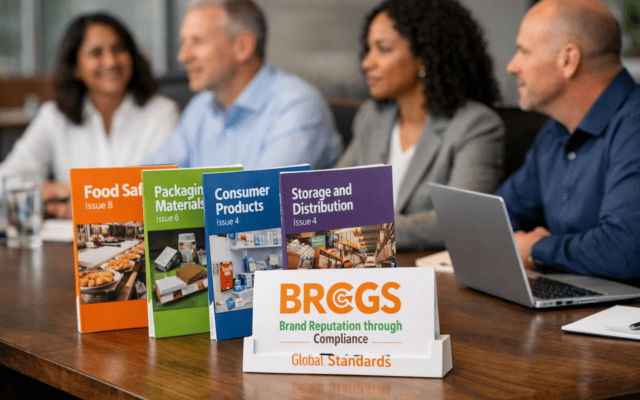
Check whether your buyers, retailers, or regulators require a specific BRCGS standard before selecting which certification to pursue. BRCGS publishes more than a dozen separate standards, each targeting a distinct part of the supply chain. Food Safety (Issue 9) applies to manufacturers, while Storage and Distribution covers logistics operators handling third-party goods.
Each standard is structured around graded audit outcomes: AA, A, B, C, and D. Suppliers awarded an AA or A grade can typically meet retailer listing requirements without additional audits. A C or D grade triggers a more frequent re-audit cycle, usually within six months, and may prompt buyers to seek alternative suppliers.
Certification is issued by BRCGS-approved certification bodies, not by BRCGS itself. The certifying body assigns auditors who assess documented procedures, physical site conditions, and staff competency against the relevant standard’s clauses. Passing an announced or unannounced audit results in a certificate published on the BRCGS Directory, which buyers and retailers use to verify supplier status directly.
Industries and businesses that require BRCGS certification
Retailers including Tesco, Lidl, and Marks & Spencer mandate BRCGS certification as a condition of supplier approval, excluding manufacturers without it from those supply chains. That commercial pressure drives uptake across food production, packaging, storage, and consumer goods manufacturing far more than any regulatory requirement.
Food and drink manufacturers face the strongest demand. Ambient, chilled, and frozen producers supplying major UK and European retailers typically need Food Safety (Issue 9) certification before a buyer will place an order. Contract and private-label manufacturers face the same requirement, since their output carries the retailer’s own brand.
Packaging producers and logistics operators encounter equivalent expectations. Food-grade packaging manufacturers are frequently required to hold BRCGS Packaging Materials certification, while third-party logistics companies often need the Storage and Distribution standard.
Consumer goods manufacturers exporting to North American or Middle Eastern markets find that buyers use BRCGS Consumer Products certification as a baseline audit requirement. Agents sourcing from multiple suppliers may also need BRCGS Agents and Brokers certification to satisfy retailer codes of conduct.
Smaller producers supplying local retailers may not face an immediate contractual demand, but certification strengthens tender applications and removes a common barrier when approaching larger buyers. The BRCGS website lists all current standards alongside their intended scope.
When BRCGS certification becomes a legal or commercial requirement
Retailer supplier codes rarely name BRCGS explicitly, yet when they require a recognised third-party audit certificate, BRCGS becomes a contractual condition by default. Losing certification means losing the contract, often without a formal notice period or right of appeal under standard supplier terms.
The Food Standards Agency does not mandate BRCGS by name, but due diligence defences under UK food safety law require documented process controls, which a current certificate provides. For export markets, several EU and North American buyers require GFSI-benchmarked certification before approving foreign suppliers, a category BRCGS satisfies. Without it, qualifying for new distribution channels typically stalls at the supplier onboarding stage.
Packaging manufacturers and consumer goods producers face comparable pressure. Liability clauses in large-format retailer tenders increasingly cite BRCGS Packaging Materials by name, and a lapsed or downgraded certificate can trigger a supplier review mid-contract, not just at renewal. Procurement teams treating certification as an annual formality often underestimate how quickly a grade change can escalate to a commercial dispute.
How to determine whether your business needs BRCGS certification
Contact your top three customers directly and ask whether their supplier approval process requires a BRCGS-recognised certificate. Most major retailers specify this in their supplier manuals, available through procurement portals.
If buyer requirements are unclear, review your product category. Food and drink manufacturers, packaging producers, and storage operators face the strongest commercial pressure to certify. If your goods enter a retail supply chain, certification is almost certain to be required at some point.
Once you have confirmed the requirement, identify the correct standard on the BRCGS standards library. Food manufacturers need Food Safety (Issue 9); logistics operators need Storage and Distribution. Applying for the wrong standard wastes audit fees and delays supplier approval.
Audit scheduling, gap assessments, and corrective actions typically take three to six months before a site is ready for inspection. Starting early preserves commercial relationships rather than repairing them after a rejected order.
Steps to begin the BRCGS certification process
Selecting the correct BRCGS standard before contacting a certification body saves significant time. Applying under the wrong standard means repeating gap analysis work and delaying audit scheduling by months. Confirm which standard your buyers or regulators require, then contact an approved BRCGS certification body to begin scoping and quotation.
A gap analysis follows registration. An assessor compares your documented systems, site controls, and records against the relevant standard, producing a prioritised list of non-conformances to resolve before the audit. Enrol staff in BRCGS courses during this stage so team knowledge keeps pace with system changes.
Once gap actions are closed, the certification body schedules a documentary review followed by the on-site audit. Unannounced audits, required for higher grading under several standards, happen within a window agreed at registration. Passing results in a graded certificate valid for 12 months, with the grade determining when your next audit falls due.
Frequently Asked Questions
Which businesses are most likely to need BRCGS certification?
Food manufacturers, packaging producers, and consumer goods suppliers are the most common candidates. Retailers such as major supermarkets typically require BRCGS certification before approving a supplier. Storage and logistics providers handling food or consumer products are increasingly expected to hold it too.
Do food manufacturers need BRCGS certification to supply major retailers?
Most major UK and international retailers require suppliers to hold BRCGS certification as a condition of listing. It is not a legal requirement, but without it, securing contracts with Tesco, Sainsbury’s, Waitrose, and similar retailers is rarely possible. Some retailers accept equivalent GFSI-recognised schemes, but BRCGS remains the most widely specified standard.
Is BRCGS certification required for food packaging suppliers?
Check your retailer and brand contracts before assuming certification is optional. Many major UK and European retailers specify BRCGS Packaging Materials certification as a condition of supply. Without it, packaging suppliers often find themselves excluded from tender processes or audited more heavily by customers.
Can a business trade without BRCGS certification?
BRCGS certification is not a legal requirement in the UK. Many retailers and food service buyers make it a contractual condition of supply, so operating without it can close off major customer channels. Smaller or direct-to-consumer businesses may face fewer barriers, but certification is often expected across most B2B supply relationships.
Do importers, storage providers and distributors need BRCGS certification?
BRCGS offers dedicated standards for storage and distribution (Storage and Distribution Standard) and agents and brokers (Agents and Brokers Standard). Importers bringing food into the UK or EU frequently require certification to satisfy retailer due diligence requirements. Distributors operating cold chain or ambient warehousing face similar expectations from major retail buyers.