What is a CCP (Critical Control Point)?
A Critical Control Point (CCP) is a specific step in a food production process where a control measure can be applied to prevent, eliminate, or reduce a food safety hazard to an acceptable level. CCPs form the operational core of HACCP (Hazard Analysis and Critical Control Points) systems, which food businesses use to manage biological, chemical, and physical risks. This article explains how CCPs are identified, monitored, and documented within a food safety management system.
Key takeaways
- Label a step a CCP only when no downstream process can correct a failure there.
- General control measures like cleaning reduce risk but sit outside the critical path.
- The Codex Alimentarius decision tree uses four sequential questions to designate CCPs consistently.
- Without a structured method, teams over-designate CCPs and dilute monitoring resources.
- Every critical limit must be a measurable parameter: temperature, time, pH, or water activity.
- Monitoring procedures must specify what is measured, how, how often, and by whom.
- CCP principles apply across food, pharmaceutical, and manufacturing sectors, but hazards and limits differ substantially.
How a Critical Control Point Differs from a General Control Measure
| Criteria | Critical Control Point (CCP) | General Control Measure |
|---|---|---|
| Definition | A step where control failure directly causes harm with no later corrective opportunity | A step that reduces risk but is not on the critical path |
| Example | Chilling cooked poultry to below 5°C within two hours; pasteurisation in dairy | Cleaning a work surface; rotating stock |
| Downstream recovery possible? | No — harm cannot be reversed by any subsequent step | Yes — another step can still prevent injury or illness |
| FSA classification | Designated CCP within HACCP plan | Prerequisite programme (foundational hygiene practice) |
| Monitoring requirement | Mandatory, documented, with corrective action plan | Standard operational hygiene procedures |
Apply the CCP label only when a control failure at that point could directly cause harm that no later step will catch. A general control measure, such as cleaning a work surface or rotating stock, reduces risk but sits outside the critical path. Skipping it creates a hazard, but another step downstream can still prevent injury or illness.
A Critical Control Point sits where the process itself must succeed. Chilling cooked poultry to below 5°C within two hours is a CCP because harmful bacterial growth at that stage cannot be reversed by any subsequent handling. Pasteurisation in dairy production is a CCP because no later step eliminates the pathogens it targets.
The Food Standards Agency distinguishes CCPs from prerequisite programmes, which are foundational hygiene practices that support safe production without constituting a critical juncture. Confusing the two produces either an unmanageable list of CCPs or, more dangerously, gaps where genuine critical points go unmonitored.
Identifying Critical Control Points Using the Codex Decision Tree
Applying the Codex Alimentarius decision tree produces a consistent, defensible CCP designation that holds up under regulatory audit. Without a structured method, teams tend to over-designate, labelling routine hygiene steps as CCPs and diluting monitoring resources.
The decision tree runs four sequential questions: whether a control measure exists, whether the step is designed to eliminate or reduce the hazard, whether contamination could reach unsafe levels, and whether a later step will resolve it. A confirmed downstream control means the current step is not a CCP; no confirmed downstream control confirms CCP designation.
Teams often stall at question four by overestimating what a later step achieves. A final visual inspection does not eliminate Listeria, so it cannot replace a validated chilling or cooking CCP. Documenting evidence at each question gives auditors a clear rationale for every designation on the HACCP plan.
Setting Critical Limits, Monitoring Procedures, and Corrective Actions
A critical limit defined too broadly makes a CCP unworkable. Every critical limit must be expressed as a measurable parameter: temperature, time, pH, or water activity. These values must be drawn from regulatory guidance or validated scientific evidence.
Monitoring procedures must specify what is measured, how, how often, and by whom. Continuous monitoring is preferred where equipment allows. Where impractical, sampling frequency must be high enough to catch a deviation before product advances to the next stage.
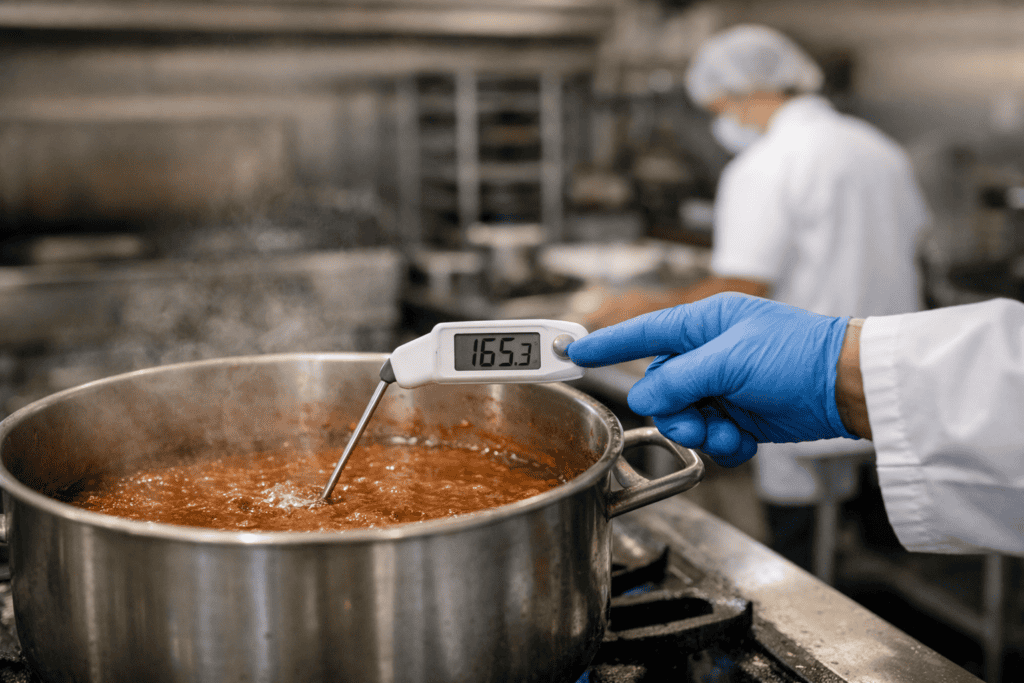
Corrective action plans are written in advance and cover three obligations: contain the affected product, restore the process to control, and record both actions. The Food Standards Agency expects corrective action records to identify the root cause, not simply confirm the deviation was resolved.
Verification confirms the entire CCP system is functioning as designed. This includes reviewing monitoring records, calibrating equipment on a defined schedule, and periodically testing finished product. A miscalibrated probe can record false readings while the monitoring procedure appears fully compliant on paper.
Critical Control Points Across Food, Pharmaceutical, and Manufacturing Sectors
Common CCPs: Pasteurisation, retort processing, and cold-chain management.
Regulatory Framework: The Codex Alimentarius Commission framework shapes most national food safety regulations. Documented CCP records must align with its structure to satisfy audits by the Food Standards Agency (FSA).
Key Example: Chilling cooked poultry to below 5°C within two hours is a CCP — harmful bacterial growth at that stage cannot be reversed by any subsequent handling.
Common CCPs: Sterilisation cycles and cleanroom pressure differentials.
Regulatory Framework: Pharmaceutical manufacturing applies risk-based control principles analogous to HACCP, with oversight aligned to Medicines and Healthcare products Regulatory Agency (MHRA) standards in the UK.
Key Distinction: Critical limits and monitoring methods differ substantially from food sector CCPs, reflecting the different nature of hazards and product sensitivity.
The principles governing CCPs apply across sectors, but the hazards, critical limits, and monitoring methods differ substantially between them.
In food manufacturing, biological hazards dominate. Pasteurisation, retort processing, and cold-chain management are the most common CCPs. The Codex Alimentarius Commission framework shapes most national food safety regulations, so documented CCP records must align with its structure to satisfy audits by bodies such as the Food Standards Agency.
Pharmaceutical manufacturing shifts focus toward chemical and cross-contamination hazards. Sterilisation cycles, cleanroom pressure differentials, and validated mixing parameters frequently qualify as CCPs under ICH Q9 risk management principles. The European Medicines Agency requires CCPs to sit within a broader Quality Risk Management system, with change-control procedures governing any adjustment to critical limits.
In general manufacturing, including metal fabrication, aerospace, and electronics, CCPs centre on physical contamination and dimensional tolerances rather than microbial growth. A heat-treatment stage or a sealed environment preventing particulate ingress can each qualify when failure cannot be remedied downstream.
Regardless of sector, a step qualifies as a CCP when the hazard is significant, the control measure at that step is the primary prevention point, and no subsequent step will eliminate the hazard if control fails. Applying these criteria prevents organisations from importing food-sector templates into pharmaceutical or manufacturing contexts where the hazard profile and regulatory expectations differ.
Frequently Asked Questions
What is a CCP (Critical Control Point) in food safety?
A Critical Control Point (CCP) is a step in food production where a control measure can prevent, eliminate, or reduce a food safety hazard to an acceptable level. CCPs are identified through HACCP analysis. Common examples include cooking temperatures, chilling stages, and metal detection checks.
How does a critical control point differ from a control point?
A control point manages quality or regulatory factors but cannot eliminate a hazard if it fails. A critical control point is specifically a step where control is essential to prevent or eliminate a food safety hazard. Missing a CCP creates a direct risk to consumer health; missing a standard control point does not.
How are CCPs identified during a HACCP study?
Apply the CCP Decision Tree at each process step where a hazard has been identified. This structured sequence of questions determines whether a control measure is essential to food safety or whether it can be managed as a prerequisite programme. The Codex Alimentarius Commission developed this tool specifically to bring consistency to HACCP team decisions.
What are the critical limits used at a CCP?
Each CCP requires at least one measurable boundary that separates safe from unsafe product. These boundaries are called critical limits. Common examples include a minimum internal cooking temperature of 75°C, a maximum pH of 4.6, or a water activity level below 0.85.
Why is monitoring a CCP necessary in a food safety system?
Undetected failures at a Critical Control Point can allow hazardous food to reach consumers before any recall is possible. Continuous monitoring creates a real-time record that confirms each control measure is working within its defined limits. Without that record, food businesses cannot demonstrate compliance to auditors or take corrective action quickly enough to prevent harm.