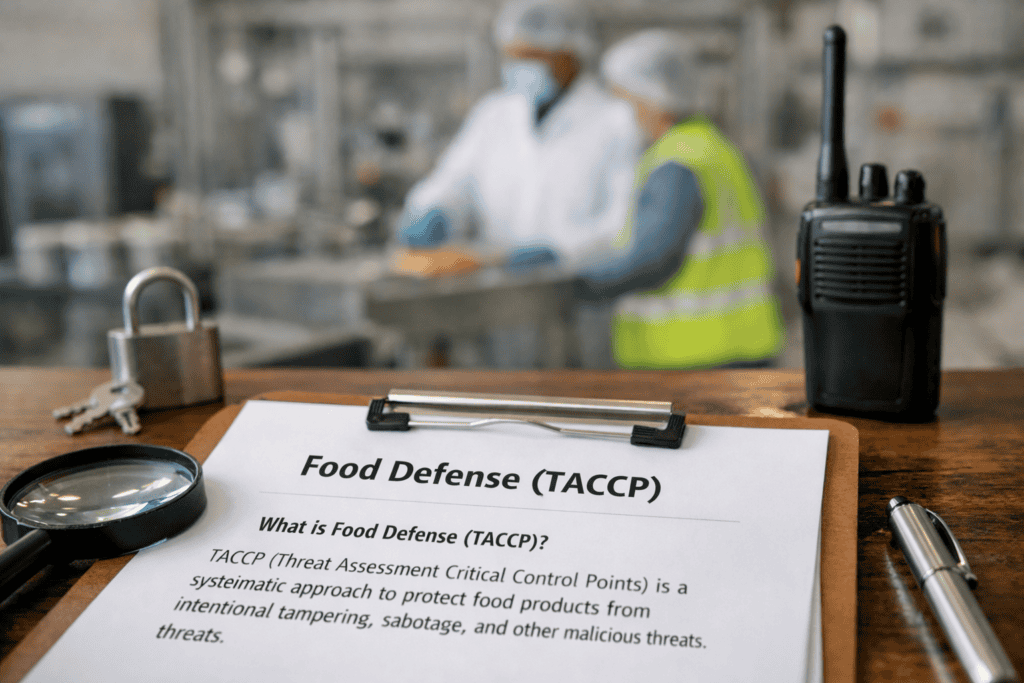
What is Food Defense (TACCP)?
Food defence, formalised under the framework known as TACCP (Threat Assessment and Critical Control Points), is a systematic process that protects food and drink products from deliberate contamination or sabotage by malicious actors. Unlike food safety, which deals with accidental hazards, TACCP focuses on intentional threats, including economically motivated adulteration, terrorism, and extortion. This article explains how TACCP works, who it applies to, and the steps food businesses take to assess and reduce deliberate threats across the supply chain.
Key takeaways
- TACCP focuses on deliberate threats such as sabotage and extortion, not accidental contamination.
- VACCP covers economically motivated fraud. TACCP deals with malicious intent, even when profit is irrelevant.
- A complete TACCP assessment includes threat identification, vulnerability analysis, likelihood scoring, and control assignment.
- HACCP uses probability-based models and assumes no hostile actor. TACCP starts from the opposite assumption.
- BRCGS Global Standard Issue 9 requires documented threat assessments, which makes certification a key compliance driver.
- A named individual should own the TACCP process and report findings directly to senior management.
- If TACCP is treated as a one-time audit exercise, critical vulnerabilities can remain unaddressed between reviews.
What Food Defense (TACCP) Means and Why It Exists
Keep food defense separate from food safety. Both operate across the same supply chain, but they address different threats. Food safety manages accidental contamination; TACCP (Threat Assessment and Critical Control Points) targets deliberate acts: adulteration, sabotage, extortion, and ideologically motivated tampering. The Food Standards Agency classifies these as malicious threats and requires a separate risk framework because conventional HACCP controls are not designed to anticipate human intent.
TACCP emerged as a formalised methodology after high-profile product tampering incidents and wider recognition that supply chain complexity creates exploitable vulnerabilities. PAS 96:2017, published by the British Standards Institution, remains the primary UK guidance document. It sets out a structured threat assessment process to identify who might attack a product, why, and where in the supply chain they could do so most effectively.
The methodology sits alongside VACCP (Vulnerability Assessment and Critical Control Points), which focuses on economically motivated adulteration such as ingredient fraud. Together, they form the broader food integrity framework that major retailers and certification bodies now require as standard audit criteria.
How TACCP Differs From Food Safety and Food Fraud Prevention
| Framework | Main focus | Threat type | Typical example |
|---|---|---|---|
| TACCP | Food defence | Deliberate malicious acts | Adulteration, sabotage, extortion, ideologically motivated tampering |
| HACCP | Food safety | Unintentional hazards | Cross-contamination and allergen carry-over |
| VACCP | Food fraud prevention | Economically motivated adulteration | Substituting cheaper ingredients or mislabelling origin for financial gain |
Food fraud prevention (VACCP) targets economically motivated adulteration, such as substituting cheaper ingredients or mislabelling origin for financial gain. TACCP addresses malicious intent, where the goal is to cause harm and profit is irrelevant.
HACCP covers unintentional hazards such as cross-contamination and allergen carry-over. It uses probability-based risk models that assume no hostile actor. TACCP starts from a different premise: a motivated adversary will seek out and exploit the weakest point. Controls must account for insider knowledge and deliberate circumvention.
A site can hold HACCP certification and robust VACCP procedures yet still face significant TACCP exposure if access controls, staff vetting, and supplier verification have not been assessed through a threat-specific lens. The STC TACCP Course trains practitioners to apply threat assessment methodology alongside existing safety and fraud frameworks. Using all three as a combined system gives food businesses the most complete protection across the full range of supply chain risks.
The Core Components of a TACCP Assessment
A complete TACCP assessment moves through four interdependent stages: threat identification, vulnerability analysis, likelihood scoring, and control assignment. A physical security checklist on its own misses the structured analysis that gives the process its value.
Threat identification maps realistic attack vectors for a specific site. These include contamination points on the production line, access routes for unauthorised personnel, and supplier interfaces where substitution could occur. Likelihood scoring then weighs each threat against the attacker profile, since an opportunistic insider and an external activist group carry different risk weightings.
Vulnerability analysis examines where controls are weakest. The Food Standards Agency recommends grading vulnerabilities on consequence severity and ease of exploitation, not probability alone. That distinction is deliberate and separates TACCP from HACCP methodology.
Control assignment matches each vulnerability to a verifiable measure. This can include tamper-evident seals, CCTV coverage, two-person rules for sensitive processes, or supplier verification protocols. Review controls whenever the site layout, workforce, or supplier base changes.
Legal and Regulatory Requirements for TACCP in the UK
UK legislation does not name TACCP directly. Still, the Food Safety Act 1990 and Food Hygiene Regulations 2006 place a duty of care on food businesses to prevent foreseeable harm. Regulators treat deliberate tampering as foreseeable, so TACCP activity falls within that duty.
Certification schemes create the strongest practical pressure. The BRCGS Global Standard for Food Safety (Issue 9) requires documented threat assessment under Clause 5.4. SQF and FSSC 22000 carry equivalent requirements. Suppliers without a current certificate are routinely excluded from major UK retail and foodservice contracts.
The Food Standards Agency supports a documented, reviewed TACCP process. Environmental Health Officers can request evidence during routine inspections. Businesses unable to produce a dated, site-specific record face enforcement risk even without a tampering incident. Reviews must be triggered by material changes: a new product line, a supplier change, a security breach, or a shift in the threat environment.
How to Implement a TACCP Plan in Your Food Business
Businesses that treat TACCP as a one-time audit exercise often leave critical gaps. A named individual should lead threat assessments, report findings to senior management, and track corrective actions. Without clear ownership, vulnerabilities can persist between audits.
Begin with a site-specific threat assessment. Map every point where product, ingredients, or packaging are accessible, then score each one for the likelihood and severity of attack. Use those scores to assign controls, including physical access restrictions, staff vetting, CCTV, and supplier verification. Document the rationale for every decision, because auditors under schemes such as BRCGS will expect to see the scoring, not just the conclusion.
Review the plan at least annually and after any significant change, such as a new supplier or product reformulation. Combine annual reviews with brief induction training on reporting procedures and an anonymous reporting channel, so concerns reach management quickly.
Frequently Asked Questions
What is food defence, and how does TACCP help protect the food supply chain?
Food defence protects the food supply chain from deliberate contamination or sabotage by malicious actors. TACCP (Threat Assessment and Critical Control Points) gives businesses a structured way to identify vulnerabilities, assess threats, and put targeted controls in place. It focuses on intentional harm, which sets it apart from food safety and food fraud processes.
What does TACCP stand for in food safety and food defence?
TACCP stands for Threat Assessment and Critical Control Points. It is a food safety risk management process that identifies and reduces deliberate threats to the food supply, such as tampering or contamination. The approach mirrors HACCP principles, but it focuses on intentional acts rather than accidental hazards.
How does TACCP differ from HACCP in purpose and application?
HACCP targets unintentional contamination caused by process failures and natural hazards. TACCP addresses deliberate threats such as sabotage, tampering, and malicious adulteration by people with harmful intent. Both frameworks assess risk at critical points, but TACCP examines human motivation and vulnerability to attack rather than accidental failure.
Which types of threats does a TACCP assessment aim to identify and control?
TACCP focuses on deliberate threats rather than accidental ones. Assessments cover malicious contamination, product tampering, sabotage, and economically motivated adulteration. They also include insider threats and external actors, including disgruntled employees, activists, and criminal groups.
Who is responsible for carrying out and maintaining TACCP within a food business?
Senior management holds formal accountability for TACCP. Day-to-day responsibility usually sits with a designated food safety or technical manager. That person leads the vulnerability assessment, coordinates the wider team, and ensures reviews happen at least annually or after any significant change to the business or supply chain.