What accreditations do STC courses carry?
STC courses carry accreditations from recognised industry bodies including CITB, CPCS, NPORS, and PASMA, depending on the specific training programme. These accreditations confirm that course content, delivery standards, and assessments meet defined sector requirements. This article outlines the main awarding bodies associated with STC’s training portfolio and explains what each accreditation means for delegates and their employers.
Key takeaways
- Check which professional body governs your target role before enrolling in any STC course.
- TVTC accredits most STC programmes, satisfying employer requirements across Saudi Arabia’s technical sectors.
- City & Guilds recognition carries greater weight with private employers and multinational firms in the Kingdom.
- TVTC accreditation functions as a baseline hiring criterion in Saudi Arabia’s oil, gas, and petrochemical industries.
- Public-sector recruitment in Saudi Arabia often treats national accreditation as a minimum requirement, not a preference.
- Your certificate alone does not confirm accreditation status. The issuing body’s registry does.
- Contact TVTC directly after completing a course to confirm your qualification is logged against your national ID.
Accrediting bodies that recognise STC qualifications
| Accrediting Body | Scope | Typical Courses | Primary Benefit |
|---|---|---|---|
| TVTC | National (Saudi Arabia) | Technical & vocational programmes | Satisfies public-sector & industrial employer requirements |
| City & Guilds | International | Selected STC programmes aligned to Vision 2030 | Recognised by multinational & private employers |
| Cisco / Microsoft | Vendor-specific | Networking, cybersecurity, cloud infrastructure | Validates technical competence for technology roles |
Check which professional body governs your target role before enrolling, as recognition varies by sector. Saudi Technical and Vocational Training Corporation (TVTC) accredits the majority of STC programmes, giving graduates a nationally recognised qualification that satisfies employer requirements across Saudi Arabia’s technical and industrial sectors.
Several STC courses also carry recognition from City & Guilds and equivalent international awarding bodies, which extends their value for candidates seeking employment or further study outside the Kingdom. Programmes aligned to Vision 2030 workforce targets tend to carry dual accreditation, combining TVTC endorsement with a recognised international framework.
Vendor-specific technical courses covering networking, cybersecurity, and cloud infrastructure are typically accredited by the relevant technology partner, such as Cisco or Microsoft, rather than a general awarding body. Confirm the accrediting body for each specific course directly with STC before registering.
How each accreditation affects your professional standing
Holding a TVTC-accredited STC qualification places candidates in a stronger position during Saudi Arabian public-sector recruitment, where national accreditation is often a minimum requirement rather than a preference. City & Guilds recognition shifts the advantage toward private employers and multinational firms operating in the Kingdom, many of whom benchmark technical competence against internationally recognised standards.
For roles in food production, manufacturing, or any process that involves a critical control point, employer expectations around certification tend to be precise. An internationally recognised accreditation carries more weight in those environments than a nationally scoped one, because auditors and procurement teams frequently require credentials that translate across borders.
Vocational credentials accredited by TVTC satisfy Saudi Aramco, SABIC, and comparable industrial employers for technician-grade appointments. Where progression toward chartered or licensed status is the goal, verifying that the awarding body maps to your professional register before enrolment saves significant time later.
Industries and roles where STC accreditations carry weight
Not every employer weights accreditations equally, and enrolling without checking sector-specific requirements is a common misstep. STC courses draw the strongest employer response where technical competency frameworks are formally enforced.
In Saudi Arabia’s oil, gas, and petrochemical industries, TVTC accreditation functions as a baseline hiring criterion. Contractors working with Saudi Aramco and SABIC typically require national qualification recognition before placing candidates in technical or supervisory roles. Vision 2030 construction projects apply similar filters during workforce vetting.
City & Guilds recognition carries the most weight in hospitality, facilities management, and food production, where multinational operators set their own internal competency standards. Health and safety roles across private and joint-venture employers frequently list internationally recognised certification as a stated preference.
Vocational training instructors and assessors also benefit directly, since Saudi training providers must demonstrate that delivery staff hold qualifications aligned with TVTC standards.
How to verify your STC accreditation after completing a course
Your certificate alone does not confirm accreditation status. The issuing body’s records do. Once you complete an STC course, contact the Technical and Vocational Training Corporation (TVTC) directly to request confirmation that your qualification has been logged against your national ID. TVTC maintains a central registry of accredited completions, and employers in the public sector routinely cross-reference this during hiring checks.
For courses carrying City & Guilds recognition, verification runs through City & Guilds’ own learner records system. Request your unique learner number from STC’s training administration team promptly after completion, as this number is required to access the international certificate record.
A common mistake is assuming the physical certificate is sufficient proof. Several multinational employers and licensing authorities require a verified digital record rather than a printed document. Requesting official confirmation from both the national and international body, where both apply to your qualification, eliminates any gap between what you hold and what an employer can independently verify.
Frequently Asked Questions
What types of accreditation do STC courses hold?
STC courses hold accreditations from several recognised awarding bodies and professional organisations. These include industry-specific qualifications, regulated certifications, and CPD-recognised programmes. The exact accreditation depends on the course type, covering areas such as health and safety, technical training, and professional development.
Which awarding bodies or professional organisations recognise STC courses?
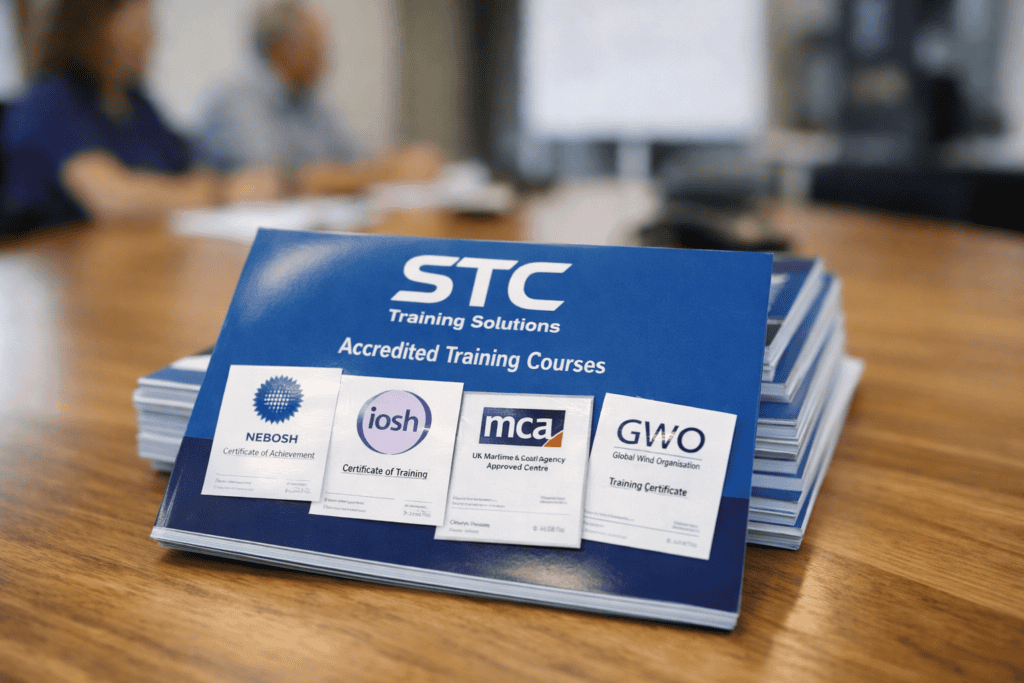
STC courses are recognised by several established bodies. These include NEBOSH, IOSH, and the Institute of Leadership and Management (ILM). Sector-specific programmes may also carry endorsement from relevant professional associations, depending on the course subject area.
Do STC course accreditations vary by subject or qualification level?
Check the specific course page before enrolling. Accrediting bodies differ across subject areas: health and safety courses typically carry NEBOSH or IOSH recognition, while management qualifications may align with CMI or ILM. Qualification level also affects which awarding organisation applies, so two courses within the same subject can carry different accreditations.
How can learners verify the accreditation status of an STC course?
Every STC course page displays its awarding body and accreditation details directly. Learners can cross-check this by searching the relevant awarding body’s public register. For regulated qualifications, Ofqual’s Register of Regulated Qualifications provides an independent confirmation of status.
Do STC course accreditations affect career progression or further study options?
Accreditations from bodies such as NEBOSH, CITB, and IOSH are recognised by employers across construction, engineering, and facilities management. They satisfy regulatory training requirements and often meet entry criteria for higher-level qualifications. Holding an accredited certificate can also support applications for professional membership with bodies like IOSH or CIOB.