PFAS in Food Packaging: The UK Regulatory Picture
PFAS, or per- and polyfluoroalkyl substances, are a group of over 10,000 synthetic chemicals used in food packaging to resist grease, moisture, and heat. UK regulators have moved to restrict several of these compounds in food contact materials, though enforcement timelines and coverage differ across product categories. This article reviews the current regulatory framework, the specific restrictions in force, and what food businesses need to know about compliance obligations.
Key takeaways
- PFAS appear in fast food wrappers, pizza boxes, and microwave popcorn bags due to grease and moisture resistance.
- No enforceable PFAS limits exist in UK food packaging law despite FSA acknowledging the concern.
- The EU’s universal restriction proposal targets all non-essential PFAS uses across the full chemical class.
- EFSA’s 2020 tolerable weekly intake of 4.4 nanograms per kilogram is already exceeded across much of Europe.
- Food, including packaged food, was identified as a primary exposure route in EFSA’s assessment.
- Major UK supermarkets have issued their own PFAS elimination timelines to packaging suppliers ahead of any law.
- The FSA has signalled that voluntary reformulation now will ease compliance once enforceable limits arrive.
What PFAS Are and Why They Appear in Food Packaging
Per- and polyfluoroalkyl substances (PFAS) are a group of more than 10,000 synthetic chemicals built around carbon-fluorine bonds, some of the strongest in organic chemistry. That structural stability is precisely why manufacturers use them in food packaging: they resist grease, moisture, and heat without degrading under normal food-contact conditions.
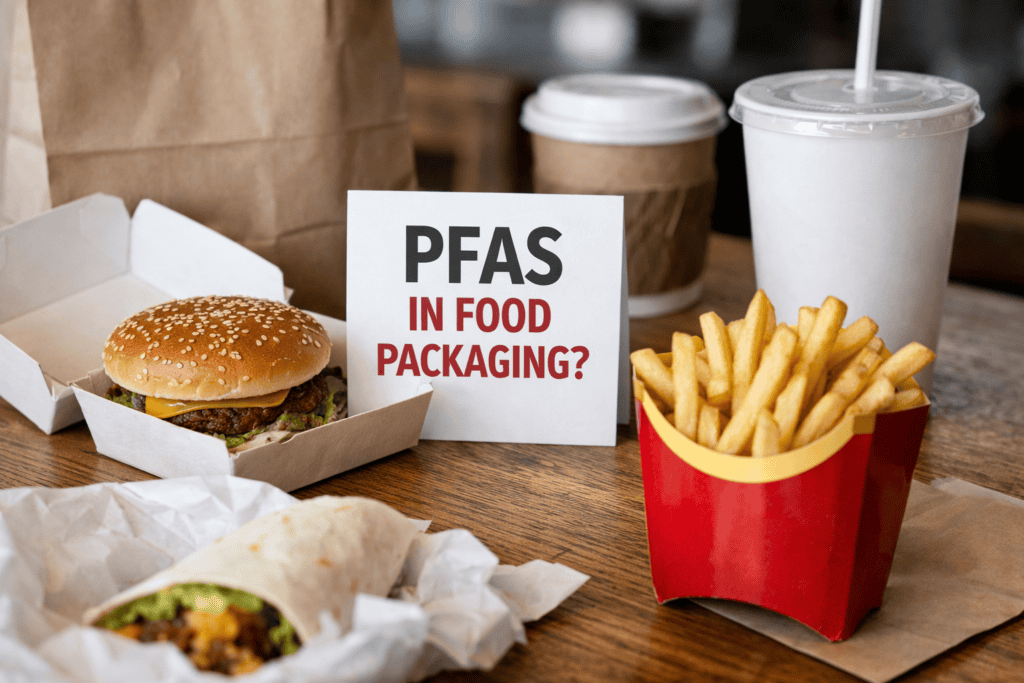
Fast food wrappers, microwave popcorn bags, pizza boxes, and baking paper are the most common applications. The fluorinated coating prevents oil from soaking through cardboard or paper, extending shelf life and maintaining packaging integrity during heating. No natural or widely available synthetic alternative currently matches that combination of properties at commercial scale.
The regulatory concern centres on persistence. PFAS do not break down in the environment or in human tissue, which is why the European Food Safety Authority and the UK Food Standards Agency classify several variants as substances of very high concern. Low-level migration from packaging into food can occur, particularly under heat, making the food-contact pathway a priority for regulators.
Current UK Regulations Governing PFAS in Food Contact Materials
Post-Brexit, the UK retained the EU’s pre-existing food contact materials framework under The Materials and Articles in Contact with Food (England) Regulations 2012, but no specific PFAS restriction exists within it. The Food Standards Agency (FSA) acknowledges PFAS as an active concern, yet enforceable limits on PFAS in food packaging remain absent from UK statute.
In 2023, five EU member states submitted a universal PFAS restriction proposal to the European Chemicals Agency (ECHA), covering food packaging among thousands of other applications. This no longer binds the UK directly, but British manufacturers exporting to the EU must still meet any restrictions eventually adopted there, creating a dual compliance burden.
The FSA monitors PFAS exposure through dietary surveillance and aligns its risk assessment with EFSA guidance. Regulatory tightening is widely anticipated, so documenting PFAS content in packaging materials now and treating traceability as part of food defence (TACCP) controls is a practical step rather than a precautionary one.
How UK Rules Compare With EU and US Restrictions
The UK sits behind both the EU and the US on PFAS food packaging restrictions, a gap that widened after Brexit removed automatic alignment with European legislative updates. The EU’s universal restriction proposal targets all non-essential PFAS uses across the full chemical class, making it the broadest food-contact restriction attempted by any major regulatory body. The US has advanced faster on specific materials, with California, New York, and others enacting state-level bans that have driven measurable reformulation across the market.
UK businesses holding BRCGS certification face immediate commercial pressure regardless of domestic law. The standard requires suppliers to demonstrate compliance with all applicable legislation and assess emerging hazards proactively. Exporters to the EU or US must meet those stricter external requirements, which is already prompting UK packaging manufacturers to audit PFAS content ahead of any formal statutory obligation.
Health and Environmental Evidence Driving Policy Change
Accumulation in human blood is now documented across all age groups and geographies, including populations with no known occupational exposure. The European Food Safety Authority’s 2020 assessment set a tolerable weekly intake for four common PFAS at just 4.4 nanograms per kilogram of body weight combined, a threshold already exceeded across much of the European population. Food, including packaged food, was identified as a primary exposure route.
PFAS do not break down in soil or water, persist in fish and wildlife, and concentrate up the food chain. Contamination of drinking water sources near manufacturing sites has been recorded across multiple UK regions, extending exposure well beyond packaging.
The FSA’s ongoing PFAS monitoring work feeds into UK Chemical Regulation and Health and Safety Executive review processes. Each new biomonitoring dataset, or dietary study linking intake to packaged food, strengthens the case for binding limits over voluntary guidance. The science points toward tighter controls; the question is how quickly UK policy will follow.
What Manufacturers and Retailers Must Do Now
Suppliers waiting for binding UK legislation face compounding risk: retailer contracts increasingly require PFAS-free certification ahead of any statutory deadline. The Food Standards Agency has signalled that voluntary reformulation now will ease compliance once enforceable limits arrive, and several major UK supermarkets have already issued their own elimination timelines to packaging suppliers.
The immediate priority is auditing current packaging lines for fluorinated treatments, particularly grease-resistant coatings on paper and board. Request written confirmation from coating and material providers, as PFAS content is not always disclosed without a direct inquiry. Plant-based barrier coatings, silicone treatments, and PFAS-free polymer films are available substitutes, and switching now avoids a forced transition under tighter deadlines.
Staff making food contact material decisions should understand the regulatory trajectory. HACCP Training and Food and Packaging Courses build the technical grounding needed to assess substitution options and document due-diligence steps that satisfy retailer requirements and future FSA scrutiny.
Retain records of material specifications, supplier declarations, and migration test results. If the UK adopts restrictions aligned with the EU universal proposal, a proactive audit trail reduces both regulatory exposure and reputational risk.
Frequently Asked Questions
What are PFAS, and why are they used in food packaging?
PFAS (per- and polyfluoroalkyl substances) are a group of several thousand synthetic chemicals valued for resisting heat, grease, and moisture. Food packaging manufacturers apply them to paper trays, wraps, and containers to prevent oils and liquids from soaking through. Their extreme chemical stability, the same property that makes them useful, means they break down very slowly in the environment and in the human body.
How are PFAS in food packaging regulated in the UK?
The UK has no single law banning PFAS in food packaging. Instead, regulation falls under the Food Contact Materials framework, where manufacturers must demonstrate that packaging does not transfer harmful substances into food. The Food Standards Agency oversees compliance, but specific PFAS restrictions remain limited compared to rules now in force across the EU.
Which types of food packaging are most likely to contain PFAS?
Check grease-resistant packaging first. Fast food wrappers, microwave popcorn bags, pizza boxes, and disposable plates are the most common carriers. Moulded fibre trays and baking paper treated for non-stick performance also frequently contain PFAS coatings.
Are PFAS banned in food packaging in the UK?
No blanket ban exists in UK law. Certain PFAS uses in food contact materials face restrictions under retained EU regulations, but comprehensive prohibition has not yet been enacted. The UK government is monitoring international developments and consulting on future measures.
How can UK businesses check whether their food packaging complies with PFAS rules?
UK food contact material regulations require full compliance documentation from suppliers. Businesses should request a Declaration of Conformity for each packaging material, confirming it meets current FSA guidelines and any applicable EU PFAS restrictions retained in UK law. Where doubt exists, an accredited laboratory can test migration levels directly.