What’s the difference between Level 2, 3 and 4 HACCP?
HACCP qualifications come in three levels, each matched to a different level of knowledge and job responsibility. Level 2 suits frontline food handlers. Level 3 is designed for supervisors and team leaders. Level 4 prepares managers and food safety officers to develop and audit full HACCP systems. This article explains what each level covers, who it is intended for, and how to choose the right qualification for your role or business.
Key takeaways
- Choose your HACCP level based on your actual role, not on time served.
- Level 2 suits food handlers and frontline staff who follow HACCP plans.
- Level 3 prepares supervisors and team leaders to write and manage HACCP systems.
- Level 2 assessments test recognition and recall. Level 3 requires application and analysis.
- UK law under Regulation (EC) No 852/2004 requires documented HACCP-based procedures.
- Auditors under BRCGS and SQF schemes expect supervisors to hold a recognised Level 3 qualification.
- Managers who take Level 2 miss the analytical depth needed to defend a HACCP plan under audit.
What Each HACCP Level Covers
Choose your HACCP level based on your role, not only on your employer’s preference. The wrong level can waste time or leave gaps in your knowledge.
Level 2 covers the core principles: identifying hazards, understanding critical control points, and following food safety procedures. It suits food handlers and frontline staff who follow HACCP plans instead of designing them.
Level 3 prepares supervisors and team leaders to develop, implement, and monitor HACCP systems. Candidates learn to conduct hazard analysis, set critical limits, and verify that controls are working.
Level 4 is aimed at food safety managers and technical leads who audit systems, manage multi-site compliance, and lead corrective action. The content aligns with Food Standards Agency expectations for senior roles. The full range of HACCP Training Courses covers all three levels and sets out clear entry requirements for each.
Who Each HACCP Level Is Designed For
Your current role and responsibilities should determine your HACCP level, not the length of time you have worked in the industry.
Level 2 is aimed at food handlers, kitchen assistants, and frontline production staff. These roles follow established food safety procedures rather than write or audit them. The course gives staff practical knowledge so they can work safely within a HACCP system.
Level 3 suits supervisors, team leaders, and catering managers who oversee others. It covers the implementation, monitoring, and maintenance of HACCP procedures. It is the standard qualification for anyone responsible for a small team or single site.
Level 4 is designed for HACCP coordinators, quality assurance managers, and senior food safety officers who design systems, conduct audits, and manage compliance across multiple sites. Many food manufacturing employers require it as a minimum for technical management roles. Highfield and RSPH both publish role-specific guidance to help match qualifications to job functions.
How the Assessment Difficulty and Depth Differ
People often choose the wrong HACCP level because they underestimate how much the assessment format changes between qualifications. Level 2 centres on recognition and recall. Candidates identify hazards, name critical control points, and describe correct procedures. Multiple-choice questions suit food handlers who follow instructions rather than write them.
Level 3 moves into application and analysis. Candidates evaluate food safety situations, select control measures, and justify decisions through short-answer or scenario-based responses. The Food Safety Courses at this level require directed study and working knowledge of food safety legislation.
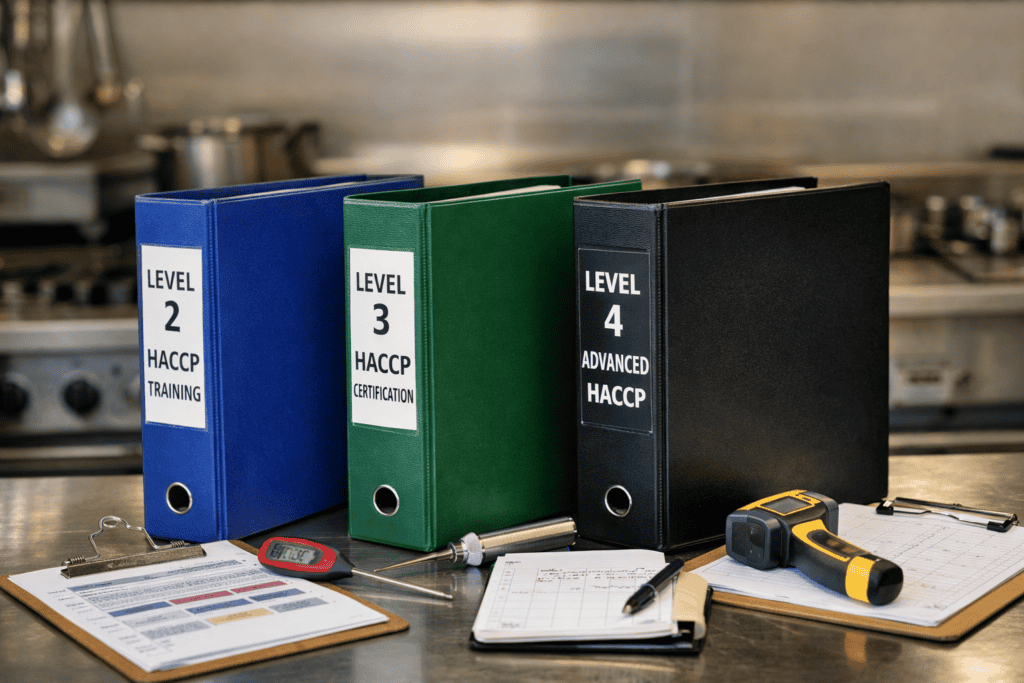
Level 4 focuses on critical evaluation and system design. Assessments require candidates to audit existing HACCP plans, identify weaknesses, and propose corrective actions grounded in technical reasoning. Coursework, extended written assignments, or portfolio evidence are standard, with a higher pass threshold than lower levels.
The step from Level 3 to Level 4 is steeper than the earlier progression. Level 4 requires independent critical thinking rather than supervised application. Completing Level 3 first, then gaining practical oversight experience before attempting Level 4, produces better outcomes than progressing through both in quick succession.
Which Level Meets Legal and Industry Requirements
HACCP is a legal requirement in the UK under Regulation (EC) No 852/2004. Food businesses must maintain documented safety procedures based on HACCP principles. Enforcement officers expect staff competence to match each role, rather than a specific qualification level.
For supervisors and managers, Level 3 is the expected standard. Auditors working under BRCGS or SQF schemes routinely check that supervisors hold a recognised Level 3 qualification. If the qualification falls below the role’s demands, auditors may flag it as a skills gap.
Level 4 applies to roles with formal oversight responsibility. Larger manufacturers, NHS catering operations, and businesses seeking higher-tier retail approval typically require at least one Level 4-qualified individual to lead HACCP development. Some industry codes aligned with FSA guidance reference this level for technical managers and quality assurance leads.
Match the qualification to the role’s actual responsibilities. A manager responsible for HACCP documentation who holds only Level 2 presents a demonstrable gap. Internal audits and local authority inspections can both identify it.
How to Choose the Right HACCP Level for Your Role
Choosing the wrong level wastes time and money. If a food handler enrols in Level 3, they face assessment questions built around supervisory responsibilities they do not hold. If a manager takes Level 2, they miss the analytical depth needed to write or defend a HACCP plan under audit.
Match the qualification to your actual duties. Level 2 suits roles that follow a HACCP plan, monitor temperature logs, and flag non-conformances to a supervisor. Level 3 is the minimum for writing procedures, training staff, or responding to audit findings. Level 4 fits responsibilities that include designing full HACCP systems, conducting internal audits, or operating within a certified scheme such as BRCGS or SQF.
If you are unsure, review the learning outcomes before enrolling. If the outcomes describe tasks you already perform daily, you likely need to move up a level. Awarding bodies such as Highfield and RSPH structure their qualifications in sequence, so each level extends the previous one rather than repeating it.
Frequently Asked Questions
What does HACCP Level 2 cover compared with Levels 3 and 4?
Level 2 covers the core principles of food safety and hazard awareness for frontline food handlers. Level 3 builds on this foundation with supervisory skills, including how to implement and monitor a HACCP system. Level 4 is for managers who develop, audit, and verify HACCP plans across an organisation.
Who should take HACCP Level 2, Level 3, or Level 4 training?
The right level depends on the job role and level of responsibility. Level 2 suits food handlers and frontline staff who need core food safety awareness. Level 3 is for supervisors and team leaders who oversee compliance. Level 4 targets managers, auditors, and those who develop or verify HACCP plans within a food business.
How does the depth of knowledge change between HACCP Levels 2, 3, and 4?
Level 2 covers core food safety principles and shows staff how to apply HACCP basics in a supervised role. Level 3 builds analytical skills and prepares staff to design and manage HACCP systems independently. Level 4 adds strategic depth, training managers to audit systems, lead teams, and demonstrate legal compliance across an entire food business.
What job roles or responsibilities match each HACCP training level?
The right level depends on how much responsibility a person has for food safety decisions. Frontline food handlers and kitchen assistants typically need Level 2. Supervisors and team leaders who monitor critical control points usually suit Level 3. Level 4 is reserved for managers, food safety officers, and those who design or audit HACCP plans.
Does completing a higher HACCP level replace the need for lower-level training?
Level 3 and 4 awards build on the foundation taught at Level 2, but they do not formally replace it. Many employers still require a Level 2 certificate to prove core food hygiene competence. Higher qualifications show supervisory or managerial knowledge, not basic operational compliance.